Self-discipline is a system, not a personality trait
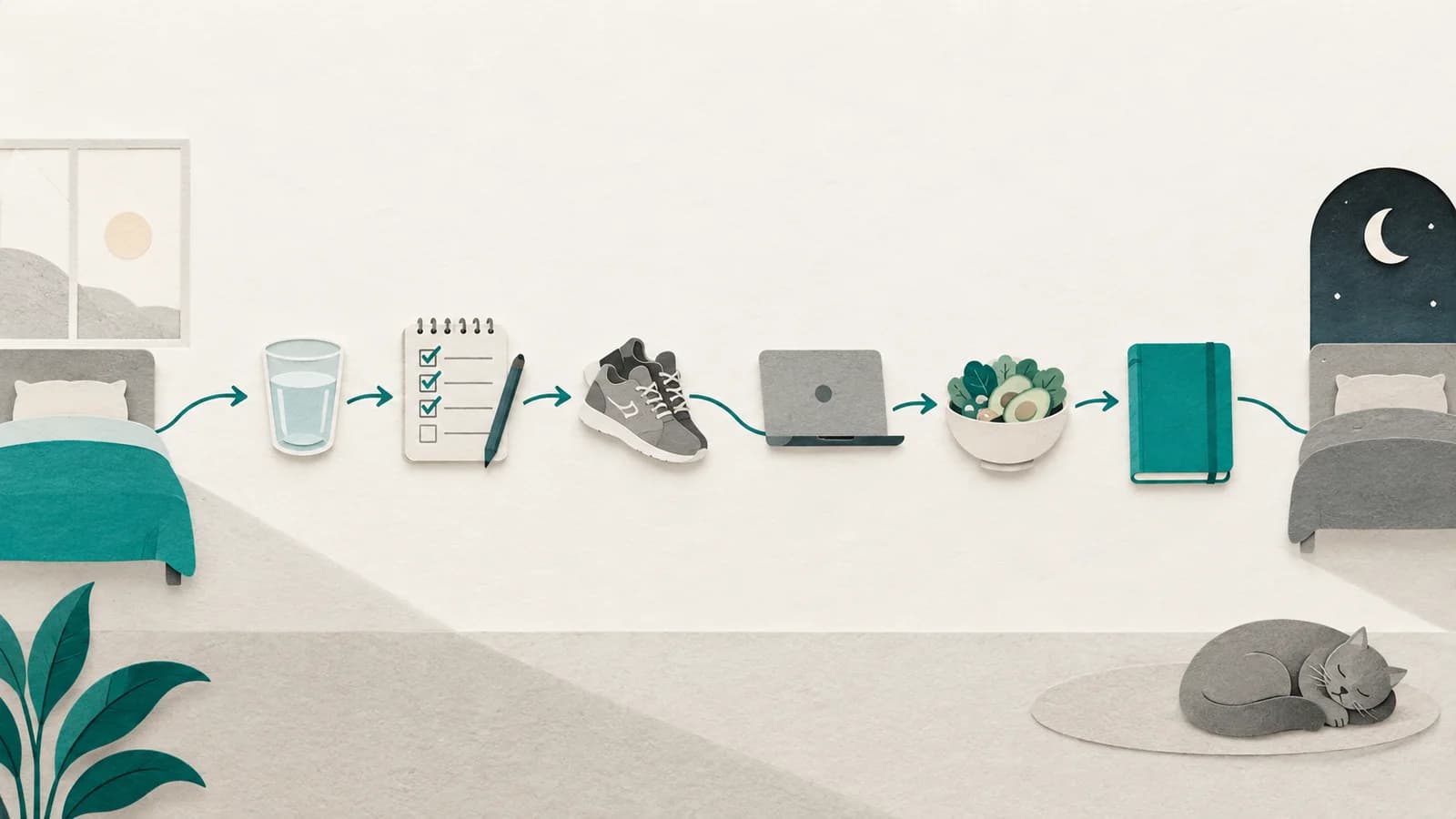
The people who look disciplined are not fighting themselves at six in the morning. Ask one of them how they get up and you will get a description of an alarm on the far side of the room, clothes on the chair, and a rule about not opening the phone until the kettle is on. You will not get a description of a struggle, because most days there is not one.
You have probably tried the other version. You decide on Sunday night that this week is different, you set three alarms, and by Wednesday you are negotiating with yourself in the dark and losing. A fortnight later the whole thing is gone, and the conclusion you draw is that you are not a disciplined person. That conclusion is wrong, and it is expensive, because it stops you from looking at the thing that actually failed.
Self-discipline is what a working system looks like from the outside. Four things do most of the work in that system: friction, defaults, precommitment and identity. All four get set up while you are calm and pay out while you are tired, which is the only arrangement that survives a bad week. Below is what each one is, what it looks like on a real Tuesday, where it breaks, and what a tracker can honestly do about any of it.
What discipline looks like from the inside
Hofmann and colleagues ran an experience-sampling study in 2012 that is worth more to you than most of the advice written since. They messaged people at random through the day and asked what they had wanted, what they had resisted, and what they had given in to. The people who scored highest on self-control were not winning more fights with themselves. They were reporting fewer fights, because their days contained fewer moments where a fight was on offer.
That is the finding to build on. The person with a reputation for discipline about sweets is usually the person with no sweets in the house. The colleague who never gets pulled into an argument on social media at eleven at night is usually the colleague who took the app off their phone in March and never mentioned it. What you are seeing from the outside is an arrangement. What they experience from the inside is the absence of the choice you are struggling with.
This matters because it changes what you work on. If discipline is a quality you either have or lack, the only move available is to try harder, and trying harder has a short half-life. If discipline is the visible output of how your week is set up, then the setup is the thing you can change on a Sunday afternoon with a notepad. That is also why the same person can look iron-willed about running and hopeless about email: two arrangements, two different results, one personality.
None of this means effort is fake. Some mornings genuinely take everything you have, and a good system spends that effort where it is scarce instead of asking for it everywhere. For the same argument as a set of steps rather than a diagnosis, how to build good habits is the longer walk through it.
The willpower story, and why it is contested
The metaphor you have heard is that willpower is a muscle: it tires as you use it, and a demanding morning leaves you with less of it at nine in the evening. The idea came out of work by Roy Baumeister and colleagues in the late 1990s under the name ego depletion, and it travelled further than almost any idea in psychology from that decade. It sits on a thousand blogs, stated as settled fact.
It is not settled. When a large group of laboratories ran a coordinated replication in 2016, all following one agreed protocol, the result did not come out the way the original account predicted, and the argument about what that means is still live. There may be a real effect in there. There is not enough of one to design your week around.
The marshmallow test has had a similar decade. Walter Mischel's studies with children and a delayed treat became shorthand for the claim that self-control is a fixed trait visible in a four-year-old and predictive of everything after. A 2018 study by Watts, Duncan and Quan re-ran the design with a larger and more varied sample, and found the link to later outcomes much weaker once family circumstances were accounted for. The children who waited were, to a large extent, the children whose homes made waiting a sensible bet.
What survives is duller and more useful than either headline. People who score well on self-control really do tend to end up with better outcomes, and when researchers look at the mechanism, it keeps coming back to habit and arrangement rather than heroic resistance. De Ridder and colleagues, reviewing the literature in 2012, found that trait self-control showed up most clearly in behaviour that had already become automatic, and least in the white-knuckle moments people picture when they use the word.
So the practical instruction is to stop treating discipline as a fuel you have a certain amount of, and start treating it as a set of decisions you can make in advance. That is what the next four sections are.
The four levers that do the work
Four levers, in the order worth pulling them. Friction and defaults change what happens when you are not paying attention, which is most of the time. Precommitment moves a decision from the moment of temptation to a calmer moment earlier. Identity is the slowest of the four and the one that keeps the other three in place after the novelty is gone.
Friction
Every behaviour has a cost in seconds and small decisions before it starts, and that cost decides more than motivation does. A guitar on a stand in the living room gets played. The same guitar in a case under the bed does not, and the owner concludes they have lost interest in guitar.
Work both directions. Take steps out of what you want more of: running clothes on the chair the night before, the book on the arm of the chair rather than the shelf, the water glass filled and standing on the nightstand before you go to sleep. Add steps to what you want less of: the phone charging in the kitchen instead of the bedroom, the social app logged out so it wants a password, the biscuits not bought on Saturday rather than resisted on Wednesday.
The move that beats all of them is to make the decision at the shop rather than at eleven at night. A house with no crisps in it does not require any self-control at all after about the third day.
Defaults
A default is what happens when you do not make a decision. Most of your week already runs on defaults you never chose: you eat what is in the fridge, you work on whatever is loudest in your inbox, you watch whatever the front page suggests.
Choosing a few of them on purpose removes a surprising amount of daily friction. Eating the same breakfast five weekdays running removes a decision from the hour when you make your worst ones. A standing block at nine that nothing is allowed to take beats a floating intention to find time. A weekday schedule that you actually keep beats a daily one you abandon every Saturday and then feel bad about on Sunday, which is the argument how to stay consistent makes at length.
The test for a default is whether it still runs on a bad day. If it needs you to be in a good mood, it is a preference wearing a default's clothes.
Precommitment
Precommitment is deciding now what the tired version of you will do later, and then removing the option to renegotiate. Peter Gollwitzer's work on implementation intentions, going back to 1999, is the clearest evidence for it: when people specify in advance when, where and how they will act, follow-through goes up compared with holding the same intention in a general form.
In practice that means writing "I will run at seven on Tuesday, Thursday and Saturday, out of the front door" instead of "I will run more". It means telling one person what time you will send the draft.
It also means deciding the shape of your working blocks before you sit in the chair. A focus session in Loggd runs from 15 to 90 minutes and can be bound to a task or a habit, so the length and the subject are both chosen while you are still standing up, rather than negotiated at minute twelve when something more interesting appears. The server measures the elapsed time and clamps it to the length you planned, so a tab left open overnight does not come back as nine hours of deep concentration. For how to pick the length, deep work in practice covers session length against the kind of work.
Identity
The slowest lever, and the one people ruin by starting too big. "I am a runner" is a claim you cannot support after two runs, and your own mind knows it, which is why saying it feels hollow. "I am someone who reads ten pages before bed" is claimable after four nights, because four nights is evidence.
Keep the claim smaller than your evidence and it does quiet work for you. On a bad Tuesday, an identity that is already true makes the ten pages the cheaper option, because acting against it costs something. Make the claim bigger than your evidence and the first missed day reads as proof you were never that person, which is how people talk themselves out of things they were three weeks into.
A day built out of the four levers
Here is an ordinary weekday with each lever doing its part. Nothing in this table requires an unusual amount of willpower on the day, and all of it required about an hour of setting up on a Sunday.
| Moment | What usually happens | Lever | What you set up instead |
|---|---|---|---|
| 06:40, alarm | you reach for the phone and read for twenty minutes | friction | phone charges in the kitchen, cheap alarm clock on the nightstand |
| 07:10, kettle on | breakfast is a decision, so some days it is nothing | default | the same weekday breakfast, bought once on Sunday |
| 09:00, first block | you open email and the morning is gone | precommitment | 45 minutes on one named task, chosen last night |
| 12:30, lunch | you eat at the desk and the afternoon blurs | default | you leave the building, ten minutes outside, no headphones |
| 17:30, leaving work | the run depends on how you feel | precommitment | Tuesday, Thursday, Saturday, out of the front door |
| 21:00, sofa | one video becomes six | friction | app logged out, book already on the arm of the chair |
| 22:30, bed | tomorrow gets decided tomorrow | identity | ten pages, then rate the day and write one line about it |
Count the decisions left in that day. There are two or three, and they happen in the morning when you are best equipped to make them. That is the whole trick, and it is why the disciplined-looking person you know seems relaxed about it.
The last row is the one people skip and then wish they had kept. A daily check-in in Loggd is a rating from 1 to 10 and one optional line, once a day, and a month of them answers questions you would otherwise argue about with yourself: which weekday is reliably your worst, and what the days after a missed habit actually look like.
Where a system breaks
Systems fail in a small number of recognisable ways, and none of them is a character flaw.
You borrowed someone else's. The five in the morning routine belongs to a person with no small children, a short commute and a home gym. Copied wholesale, it fails in week two and takes your confidence with it. Take the levers, not the timetable.
You built too much at once. Five new habits in January are five simultaneous experiments with no control, and none of them is a system. One habit, made small enough to be nearly free, is the version that is still running in March. Tiny habits and the two-minute rule is the case for starting smaller than feels reasonable, and the case is stronger than it sounds.
You missed a day and then treated it as a verdict. One missed day is weather. Two in a row is the beginning of a different pattern, so the rule worth holding is simply that you do not miss twice. The day after a miss is the one that decides most of it, and doing the smallest possible version that day counts fully.
It was never a habit. "Learn Spanish" is a goal, "twenty minutes of Spanish after dinner" is a habit, and "book the exam" is a task. Trying to check off a goal every evening feels like failure by design, because there is no version of it that finishes in a day.
The honest part: the first two weeks of any new setup feel like effort, because you are still making the decisions the system has not absorbed yet. That period is what installation feels like rather than evidence that you lack discipline.
What a tracker can and cannot do
A tracker cannot supply discipline. It records what happened and shows you where a working arrangement is leaking. It will not invent an arrangement you have not made, and any product that suggests otherwise is selling you a feeling.
The honest alternatives are worth naming. A wall calendar and a pen is genuinely enough for one habit, costs nothing and never asks for a subscription. Streaks or Loop suit people who want one screen and no ceremony. Habitica works for people who are actually motivated by the game layer, which is a real thing about some people and not about others.
Loggd sits in a different place. Habits, tasks, goals, focus sessions and a daily check-in are in one app, and the year comes back as a 365-day grid on the home screen: check a habit off and one cell fills, and a missed day is one grey square among the filled ones. The free plan includes three habits, which is a low number until you remember that three kept habits beats eight abandoned ones. Streaks are worked out from your entries rather than stored, so a streak whose last entry was yesterday is still running, and nothing in the app sends you a warning about it, because the day is not over until it is over. If you want to see how the pieces fit together before signing up for anything, the guide walks through the whole thing, and the landing page is the short version.
Common questions about self discipline
Can you build self discipline, or are you born with it?
You can build it, but probably not the way the phrase suggests. Very little evidence supports the idea of training a general willpower capacity through practice at resisting things. Plenty supports the idea that surroundings carry behaviour: change what is easy, what is default and what has already been decided, and the behaviour follows.
How long does it take to build discipline?
Longer than a week and shorter than you fear, and the honest answer is a range rather than a number. A specific behaviour attached to a stable cue starts to feel unremarkable somewhere between a few weeks and a few months, depending on the behaviour, and the middle of that range is a lot further out than the twenty-one days you have been told about.
What is the difference between discipline and motivation?
Motivation is how you feel about doing the thing, and it moves hour to hour for reasons that have nothing to do with the thing. Discipline, in the sense used here, is the set of arrangements that means the behaviour happens on the days when the feeling does not arrive. Building a system on motivation is building on a floor that moves.
How do I build discipline when I am exhausted?
Shrink the commitment until it fits the energy you actually have, and keep it on the schedule. Two minutes of the habit on a bad day keeps the setup intact, and the setup is what you are protecting. If exhaustion has been the whole story for weeks rather than days, that is worth raising with a doctor rather than solving with a tracker.
Do habit trackers actually help with self discipline?
They help with two specific things: remembering what you decided, and seeing the pattern later. They do nothing for the moment of resistance itself. If you keep opening the app and closing it without doing anything, the problem is the size of the habit or the strength of the cue, and neither is fixed by a better app.
Pick one lever tonight and use it once. Move the phone charger to the kitchen, or decide the length and the subject of tomorrow's first block before you go to bed. Then look again in a month, when there is a month of days to look at rather than an opinion about yourself, and the guide will show you what the rest of the setup looks like.
Read next
How long does it take to form a habit? Longer than 21 days, and that is fine
The honest answer runs from a couple of weeks to most of a year, and a single missed day barely moves it.
9 Sept 2026~12 min
How to build good habits: a system that survives a bad week
Seven steps, each with an example you can set up tonight, built around the bad week that usually ends things.
9 Sept 2026~13 min
Tiny habits and the two-minute rule: start smaller than feels reasonable
Shrink the habit until the version you would do at 11 pm on a bad day is the version you promised.
9 Sept 2026~11 min