The habit loop: cue, routine, reward, and how to redesign each
You did not decide to pick up your phone. Your hand was already moving by the time you noticed, and thirty seconds later you were two screens into something you will not remember tomorrow. Nobody chose that. A sequence ran, the way it has run a few thousand times before, and you came along with it.
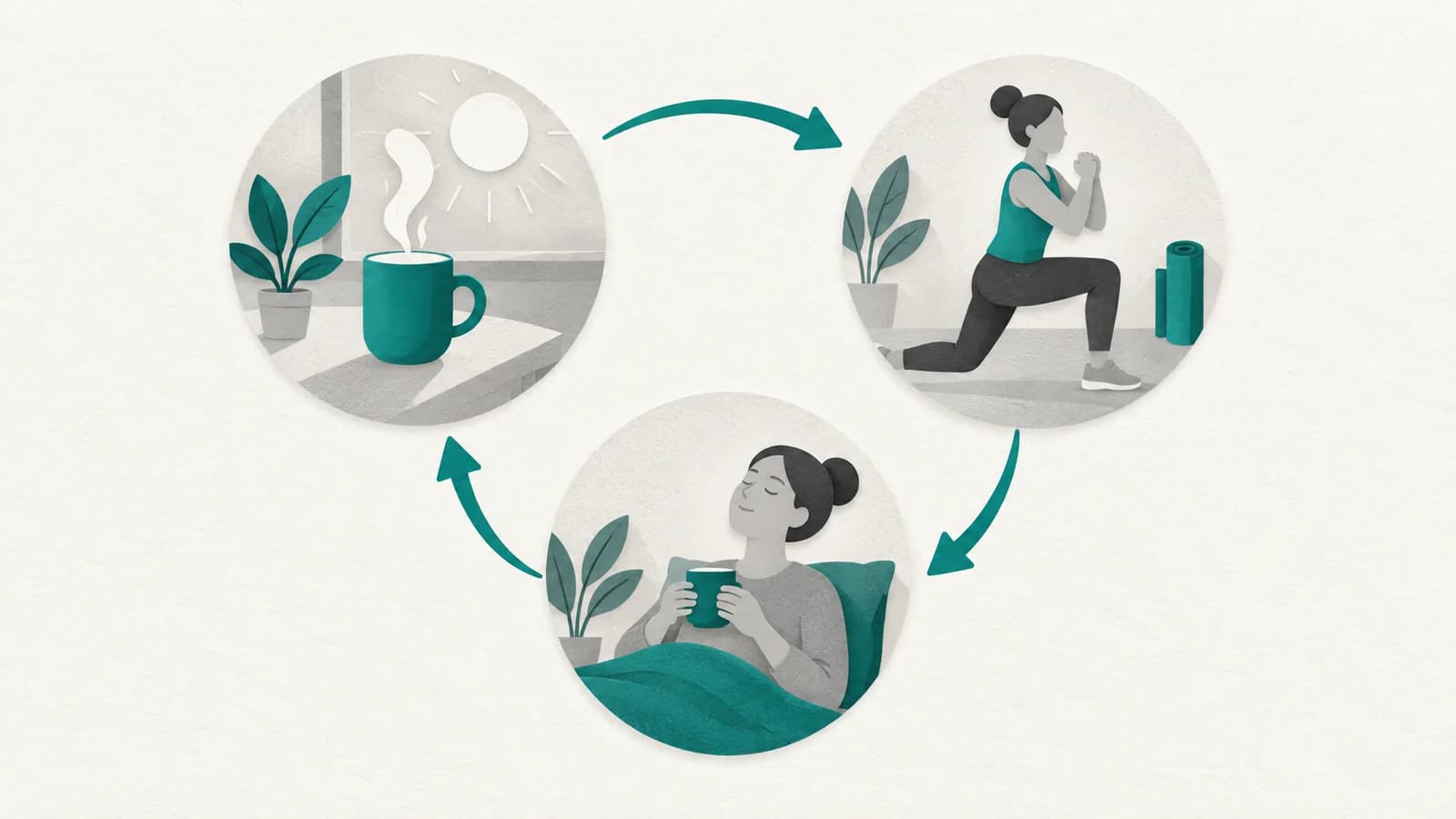
That sequence is what people mean by the habit loop. Something starts the behaviour, the behaviour happens, and something at the end of it makes the whole run more likely next time. Charles Duhigg gave the three parts their usual names in The Power of Habit in 2012: cue, routine, reward. The names stuck because they are the right size to work with. You can point at each one in a behaviour you actually have, and you can change one of them on a Tuesday.
This article takes the three parts in turn and shows what changes when you touch only one of them. Then it maps the loop onto a habit tracker, because if you use one, it is already running a loop on your behalf, and it is worth knowing which part is doing the work.
What the habit loop is
The cue is whatever starts the sequence. It is nearly always one of five things: a time, a place, the action immediately before, the people you are with, or how you feel. The routine is the behaviour itself, the part you would name if someone asked what the habit is. The reward is what the behaviour pays you at the moment it happens, which is usually not what you would say it pays you if asked in the abstract.
Take the eleven o'clock scroll. The cue is not the hour. It is the specific moment the bedroom light goes off and there is nothing left that has to be done. The routine is the phone. The reward is not entertainment, because you are barely reading. The reward is a few minutes in which nobody, including you, requires you to think about the day you just had.
Naming those three honestly is most of the work, and it is harder than it looks, because the reward is rarely the one you would list first. James Clear cut the loop into four parts in Atomic Habits in 2018, adding the craving between the cue and the response, which is a useful distinction: the cue is what you noticed, the craving is what you wanted from it. Wendy Wood's work points somewhere else again, at context. In Good Habits, Bad Habits, published in 2019, she makes the case that where and when a behaviour happens predicts whether it keeps happening better than how much you say you want it.
None of these has to be exactly right for the practice to work. The loop is a shape to think with, and its value is that it gives you three separate things to change instead of one large thing called willpower. You are not doing neuroscience here. You are trying to read ten pages before bed instead of scrolling.
The cue is worth a closer look before anything else, because it is the part most likely to be quietly unstable. Plenty of habits that die in week three die because the cue quietly moved and nobody noticed.
| Cue type | An example that holds | What makes it unstable |
|---|---|---|
| Time | 07:10, after the alarm and before the shower | A weekend that starts three hours later |
| Place | The mat that lives in front of the wardrobe | Travel, or a tidy-up that puts the mat away |
| Preceding action | The kettle clicking | A morning when someone else made the coffee |
| People | A colleague standing up for lunch | Their day off, their new job |
| Feeling | The flat patch at four in the afternoon | It arrives at a different hour after a bad night |
Redesign one part at a time
The reason to change one part at a time is dull and decisive: if you change all three at once and the habit sticks, you have learned nothing you can use on the next one. Change the cue this fortnight. Change the size of the routine next month, if it still needs it.
Start with the cue, because it costs you nothing in the moment
A cue change is free at the moment of doing. You are not asking yourself for more effort, you are moving where the effort gets asked for.
The commonest broken cue is a region of the day pretending to be a moment. "Read in the evening" is a region. "Read after I put the phone on the charger in the kitchen" is a moment, and it has a physical object in it. "Stretch in the morning" is a region. "Stretch while the coffee brews" is a moment with a fixed length attached.
Pick something you already do without deciding, and put the new thing immediately after it. That is the whole of habit stacking, and it works because you are borrowing a cue that has already proven it fires every day. If the anchor only exists on some days, say the school run or a Tuesday gym class, then the habit belongs on those days rather than on all seven, and the schedule should say so.
Shrink the routine until the cue can carry it
A cue only pulls so much weight. If the routine on the other end is forty-five minutes of reading, the cue has to overcome forty-five minutes of anticipated effort every single night, and on the nights it fails it also teaches you that this cue does not lead anywhere.
Shrink the routine until the cue can pull it on your worst day. Ten pages. One page. The guitar out of the case and back in, for a week, which sounds absurd and is the version people actually keep. Tiny habits and the two-minute rule goes through the sizing properly, including why the small version is the mechanism rather than a compromise you make until you are stronger.
The test is not whether the routine is impressive. The test is whether you would still do it at 11 pm on a day that went badly, because that is the day that decides whether the loop survives.
Make the reward small and immediate
The reward has to land while the behaviour is still in the room. Four kilos in March is not a reward for the walk you took on a Tuesday in January, however much you want it to be. Between the walk and March there are sixty days in which the loop gets no signal at all.
What works is unglamorous: the line drawn through the row, the cell that fills, five minutes of sitting down afterwards with the coffee you did not have before, one sentence to one person. BJ Fogg's Tiny Habits, published in 2019, makes a small deliberate celebration part of the method rather than an afterthought, and the reason is exactly this: the behaviour needs an answer immediately, and you are the only one there to give it.
If the habit is one where the natural reward is genuinely delayed, borrow one. A record you can see is the usual borrowed reward, which is why trackers work at all, and why the ones that work best make the marking itself the pleasant bit.
Change one thing, then give it a fortnight
Two weeks is roughly the shortest span that tells you anything, because the first week is novelty and the second is the first honest one. Write down which part you changed and on what date. A daily check-in of a rating and one line is enough of a record for this, and it takes about ninety seconds.
Changing a loop you already run
For a habit you want less of, the standard move is Duhigg's: keep the cue, keep the reward, swap the routine.
The four o'clock biscuit is the textbook case, and it is worth walking properly. The cue is the flat patch after lunch. The routine is the walk to the tin. The reward, if you are honest, is often not sugar at all, it is five minutes of not being at the screen and a short conversation with whoever is in the kitchen. If that is the reward, a walk to the kettle and back does the same job, and you will know within a week because the craving either settles or it does not.
You will get the reward wrong the first time. That is normal, and it is the reason this is a test rather than a plan. Try one substitute for a week, notice whether the pull is still there at four o'clock, and try a different substitute if it is.
The other move is to take the cue away, which is usually a question about your rooms rather than your character. The phone charging in the kitchen removes a cue that fires the moment the light goes off. The app removed from the home screen adds four seconds of friction, and four seconds is often enough at the exact moment the behaviour is automatic rather than chosen.
Some loops do not yield to any of this, particularly the ones tangled up with sleep, alcohol or a bad stretch of life. Rearranging a cue is a reasonable thing to try and a poor thing to insist on. If a behaviour is doing real damage, the useful next step is a person with training, not a better anchor.
What the loop looks like on a tracker
A habit tracker is a habit loop with the parts made explicit, whether or not it was designed that way. The paper version is the clearest: a calendar on the kitchen wall is the cue because you walk past it, the habit is the routine, and the cross in today's box is the reward. Nothing about that needs a screen, and for some people the pen is the reason it works.
The app versions differ mostly in what they do about the reward. Habitica turns it into a role-playing game with a party, quests and damage taken when you skip, which is genuinely the right answer for people the game keeps hooked and the wrong one for everybody else. Streaks puts a small number of habits on one screen and does nothing else, which is a real design position. Loop Habit Tracker is open source, free and Android-first, and its name is a coincidence rather than a claim about this article.
Loggd takes the quiet position. The schedule is the cue: a habit runs daily, on weekdays, or on a custom set of weekdays, so the row appears on the days it is meant to and stays out of sight on the days it is not. The check-off is the routine, and a target per day sets how many taps finish the day, so a habit of three glasses of water is complete at three and further taps do nothing. The reward is the cell filling on the 365-day grid on the home screen, the same shape as a contribution graph, one square per day for a year.
| Part of the loop | On a paper calendar | In Loggd |
|---|---|---|
| Cue | The calendar hangs where you walk past it | The schedule decides which days the habit row is there, and the browser extension has an optional nudge that puts today's remaining habits in front of a feed you were about to scroll |
| Routine | Whatever you wrote in the margin | The habit itself. A target of three means three check-offs finish the day |
| Reward | A cross in today's box | Today's cell fills on the 365-day grid |
The reward is deliberately small. A check-off does one visible thing, which is fill the cell. XP moves in the background, ten for a habit check-off, and it is a running total rather than an event. Nothing plays a sound, nothing animates across the screen, and no character arrives to congratulate you on a glass of water.
That restraint runs the other way too. A streak is worked out from the entries rather than stored, and a streak whose last entry was yesterday is still your current streak, because today is not over yet and the app has no business telling you otherwise. Nothing in the product counts down at you or warns you about a day you still have time to finish.
What usually goes wrong
The cue is a region, not a moment. "In the evening" and "at some point in the afternoon" are not cues. Find the physical thing that happens first: the kettle, the charger, the last meeting ending, the front door closing.
The reward is in the future. If the only payoff arrives in three months, the loop has nothing to run on tonight. Borrow one, and make the marking itself feel like the finish rather than admin.
The routine is a goal wearing a habit's clothes. "Get fit" cannot be a routine because you cannot do it once. "Twenty minutes of walking after lunch" can. It is one of the commonest reasons a habit list stops making sense after a fortnight, and how to build good habits works through the split between goals, habits and tasks in more detail.
Three changes at once. New cue, smaller routine, new tracker, all on the first of the month. When it works you cannot say why, and when it stops you have three suspects.
The day after the miss. One missed day is noise and every long run of days has some in it. The day after is where the pattern actually gets decided, and the useful rule is to treat it as an ordinary day rather than as evidence about yourself. The grid will show one grey cell among the filled ones, which is what a real year looks like.
Habit loop FAQ
What are the three parts of the habit loop?
Cue, routine and reward. The cue starts the behaviour, the routine is the behaviour, and the reward is what it pays you immediately afterwards, which is what makes the sequence more likely next time.
Where does the habit loop come from?
Charles Duhigg popularised the three-part version in The Power of Habit in 2012, drawing on research about how repeated routines get stored and run with less deliberate attention. James Clear later used a four-part version in Atomic Habits in 2018, splitting out the craving between the cue and the response.
How do I find the cue for a habit I want to change?
Catch yourself in the act for a few days and write down five things each time: the time, where you were, what you had just finished doing, who was there, and how you felt. One of those five will repeat. That is the cue, and it is often not the one you assumed.
Can I change the reward instead of the routine?
You can, and it is usually harder, because the reward is the part you have least control over. The standard move is to keep the cue and the reward and change the routine that sits between them, which is why the walk to the kettle can replace the walk to the biscuit tin without the four o'clock pull getting worse.
How long before a loop runs on its own?
Longer than the number you have heard, and it varies enormously by habit and person, from a few weeks to most of a year. How long it takes to form a habit goes through the research and where the 21-day figure actually came from.
Does the habit loop work for stopping a habit as well as starting one?
Partly. Removing a cue and substituting a routine both help, and both are worth trying first because they are cheap. Habits tied to sleep, alcohol or a difficult period in your life are a different problem, and the loop is a poor substitute for proper help with those.
Pick the one loop that annoys you most, write its three parts on a single line each, and change exactly one of them for a fortnight. If you want the parts already laid out for you, the schedule, the check-off and the grid do that job, and the guide walks through setting the first one up.
Read next
How long does it take to form a habit? Longer than 21 days, and that is fine
The honest answer runs from a couple of weeks to most of a year, and a single missed day barely moves it.
9 Sept 2026~12 min
How to build good habits: a system that survives a bad week
Seven steps, each with an example you can set up tonight, built around the bad week that usually ends things.
9 Sept 2026~13 min
Self-discipline is a system, not a personality trait
The people who look disciplined are not winning more fights with themselves, they are having fewer, and that is something you can arrange in advance.
9 Sept 2026~13 min