Habit stacking: anchor new habits to the ones you already keep
You brushed your teeth this morning without deciding to. You filled the kettle at the same point in the sequence you always fill it, you picked up your phone at the same point you always do, and if someone asked you at what minute any of it happened you would have to guess. That part of your morning runs itself, and it has run itself for years.
Now think about the thing you have been meaning to start. Flossing, ten push-ups, five minutes of Spanish, one glass of water before coffee. You know what it is and you know it takes almost no time, and it still has not happened, because it has no place to live. Every morning it has to win an argument against everything else, and it loses on merit, because the other things are not arguing.
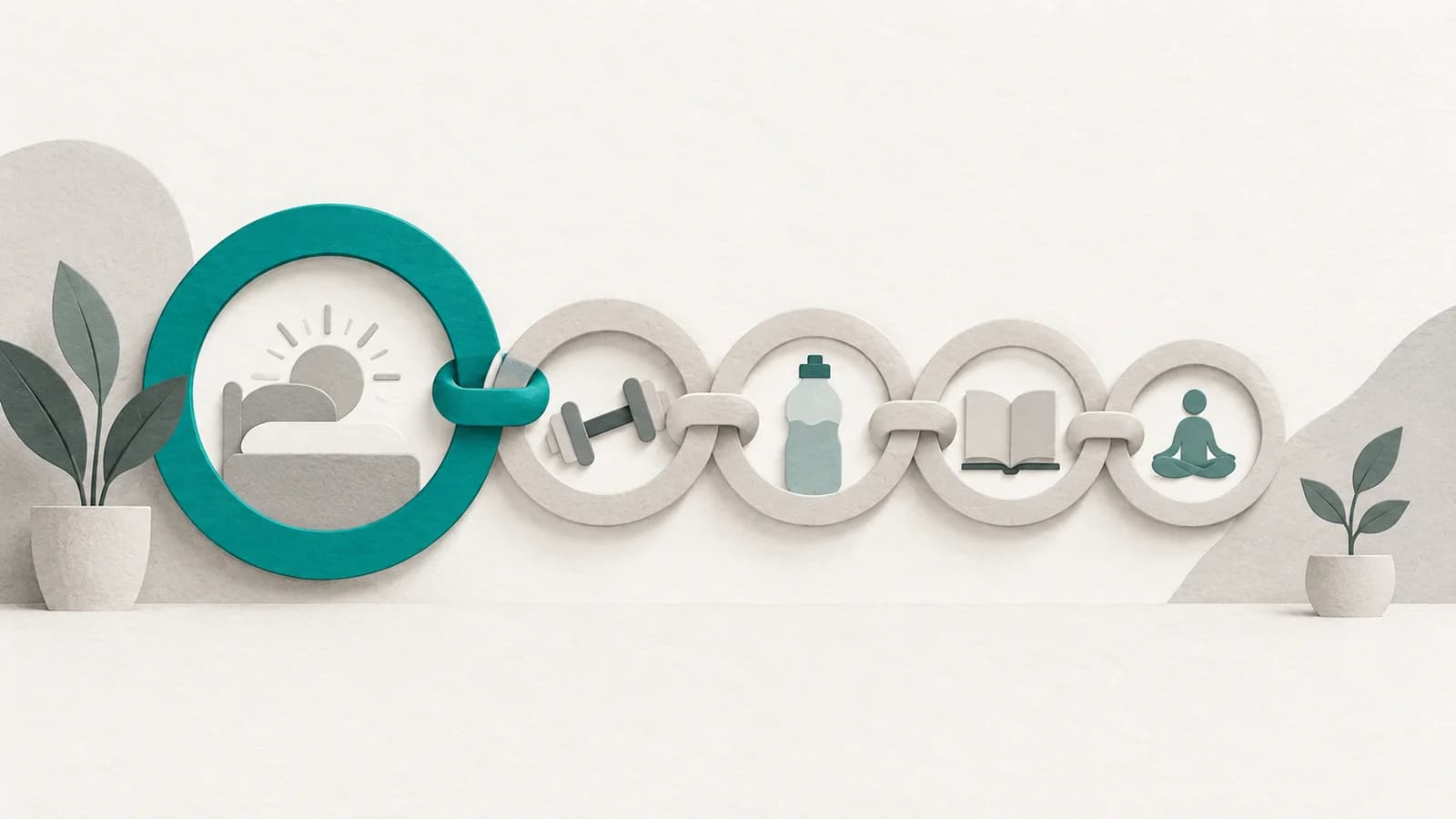
Habit stacking gives the new thing a place. You attach it to a behaviour that already happens on its own, so the old behaviour becomes the cue for the new one. BJ Fogg calls the existing behaviour an anchor in Tiny Habits (2019), and James Clear popularised the name habit stacking in Atomic Habits (2018). The formula is one sentence: after I do the thing I already do, I will do the new thing. What follows is how to pick an anchor that holds, twenty worked examples you can take as written, and the failure mode that accounts for most collapsed stacks.
What habit stacking actually is
A stack is a sentence with two halves: after [something you already do without deciding], I will [the new thing]. After I pour my first coffee, I will write down the one task that has to happen today. After I put the dinner plates in the sink, I will set a timer for five minutes and tidy the kitchen.
The reason it works better than a reminder is that the cue is a behaviour rather than a time or a good intention. A behaviour you already perform brings its own context with it: you are in a particular room, holding a particular thing, at the moment a particular action finishes. Wendy Wood and colleagues have spent decades documenting how much of daily behaviour is repeated in the same place at the same point in the same sequence, and it is a larger share of the day than people assume. Habit stacking borrows that stability rather than trying to build new stability from nothing.
It also solves the hardest part of a new habit, which is not doing it but remembering to. Most people who "forgot" to floss did not forget how, they never had a moment assigned to it. A stack assigns one, and the assignment is enforced by something you were going to do anyway. If you want the mechanism underneath this rather than the recipe, the habit loop takes the cue, the routine and the reward apart one at a time.
What makes an anchor hold
Plenty of existing behaviours make poor anchors. Three properties separate the ones that hold from the ones that quietly stop working in week three.
It happens without a decision. The anchor should be something you would do today even if you had never heard of habit stacking. Brushing your teeth qualifies. "My morning workout", if the workout is itself a habit you are still trying to build, does not. Stacking a new habit on a shaky one gives you two things that fail together.
It happens in roughly the same place at roughly the same point. "After breakfast" is weak if breakfast happens at the table on Monday, in the car on Tuesday and not at all on Thursday. "After I put my empty mug in the sink" is strong, because the mug and the sink are in one place and the action has a clear finish.
It has an obvious end. The best anchors click, close or land: the kettle finishes, the front door shuts, the laptop lid closes, the shower stops. An anchor with a fuzzy ending gives the new habit a fuzzy start, and a fuzzy start is where it goes missing.
One more rule that saves a lot of frustration: the anchor has to happen as often as you want the new habit to happen. A daily habit needs a daily anchor. If you want something five days a week, anchor it to something that only exists on those five days, like leaving the office, rather than to something that happens every day but changes shape at weekends.
Twenty habit stacking examples
Take one of these as written if it fits your day. Adapting an example is fine, inventing four at once is not, because the point of the first week is to find out whether the anchor holds.
| When | After this anchor | Do this |
|---|---|---|
| Morning | your feet touch the floor | drink the glass of water you left on the nightstand |
| Morning | you press the switch on the kettle | ten push-ups while it boils |
| Morning | you brush your teeth | floss one tooth, and stop there if you want to |
| Morning | you pour the first coffee | write the one task that has to happen today on a card |
| Morning | the front door shuts behind you | name out loud the first thing you will do at your desk |
| Morning | you sit down at your desk | put the phone in the drawer, face down |
| Work day | you open the laptop | open the task list before you open email |
| Work day | the first meeting ends | walk to the far end of the building and back |
| Work day | you refill your water bottle | two minutes of stretching against the wall |
| Work day | you finish eating lunch | ten minutes outside without headphones |
| Work day | you close the laptop for the day | write tomorrow's first task on the same card |
| Evening | you take off your work shoes | put your running shoes by the door |
| Evening | the dinner plates go in the sink | play one song and tidy the kitchen while it runs |
| Evening | you start the dishwasher | five minutes of language practice on the phone |
| Evening | the children are in bed | ten pages of the book on the arm of the chair |
| Evening | you plug the phone in to charge in the kitchen | read in the bedroom instead of scrolling in it |
| Evening | you brush your teeth at night | rate the day from 1 to 10 and write one line about it |
| Weekend | you carry the bins out | look at your grid and pick one habit to keep and one to drop |
| Weekend | you sit down with Sunday coffee | write the three things next week has to contain |
| Weekend | you finish the weekly shop | put fruit at eye level and the biscuits out of reach |
Two things to notice. Almost every new habit in that list is small enough to be nearly free, which is deliberate: a stack fails when the second half is heavy, and a heavy habit needs building on its own before it can hang off anything. Tiny habits and the two-minute rule makes the case for starting smaller than feels reasonable.
The other thing is that several of them work by moving an object rather than by trying harder. The shoes by the door, the book on the chair, the phone charging in another room. The anchor gives you the moment, and the object removes the friction inside it.
Build your own stack in four steps
1. Write down the sequence you already run
Before you add anything, write out what actually happens between waking and leaving, in order, in whatever detail you can remember. Most people end up with more steps than they expected, and most are surprised by how fixed the order already is. This is your list of candidate anchors, and it is more reliable than the routine you think you have.
Do the same for the hour after you get home, which is usually the loosest hour of the day and therefore the one with the most room in it.
2. Pick the seam, not the busiest minute
Look for a gap in the sequence where you are already waiting: the kettle boiling, the shower warming, the computer starting, the child putting shoes on slowly. These seams are dead time you cannot fill with anything useful anyway, and a habit dropped into one takes nothing away from the rest of the morning.
Avoid the minute where you are already late. Anything you stack onto leaving the house at 08:12 will be the first thing dropped on the morning that starts at 08:20.
3. Shrink the new habit until it fits the seam
If the seam is ninety seconds, the habit has to be smaller than ninety seconds, at least at the start. The promise is "sit down and take ten breaths" rather than "meditate", and "open the app and do one exercise" rather than "study Spanish". You are allowed to do more once you are there, and you usually will, but the version you promised yourself has to fit the gap or the stack starts to feel like a debt.
4. Say the sentence, then put it in the order you do it
Write the full sentence somewhere you will see it for the first fortnight. A card by the kettle beats a note in an app you have to open, because the card is already in the room where the anchor happens.
Then put the habit into whatever you track with, in the position it occupies in your actual day. Habits in Loggd are ordered in the list, and you move one up or down with a pair of arrows, so the new habit can sit directly under its anchor and the morning reads top to bottom in the order you do it. Worth being clear about what that is and is not: the app does not link one habit to another, and checking off the first does nothing at all to the second. The order is a description you write for yourself, and it is useful for exactly that reason, because the list stops being an unsorted pile of intentions and starts reading like a sequence.
If the anchor only exists on some days, a habit can run on a custom set of weekdays rather than every day. The five-days-a-week language practice that hangs off leaving the office should be a weekday habit, so that Saturday is not counted as a day you failed to do something that was never available.
Why stacks fail, and it is almost always the anchor
When a stack quietly stops, people usually blame their own consistency. Look at the anchor first, because that is where the fault nearly always is.
The anchor moved. The commute changed, the office closed two days a week, the lunch break drifted from 12:30 to whenever the meeting ends. Wood and colleagues found in 2005 that when students moved to a new campus, habits that had been running for years were disrupted, and the ones that survived were the ones whose context came with them. Your habit did not weaken. Its cue went missing.
The anchor was never as stable as it looked. First coffee is a good example: at seven on weekdays, at eleven on Sunday, and at whatever time the visitors leave on Saturday. Anything stacked on it inherits that variance. Either accept the habit is a weekday habit and schedule it as one, or move it to something that happens at the same point every day of the week.
Too much is hanging off one anchor. A stack of five things after brushing your teeth is a morning routine with a cue at the front, and it fails as a block the first time you are late. One anchor, one new habit, until the new one has stopped needing the reminder.
The second half was too big. "After I get home, I will do a 45 minute workout" is not a stack, it is a plan with a cue taped to it. The anchor can start a behaviour, it cannot carry one.
The anchor is itself a new habit. Stacking onto something you are still building means one bad week takes out both. Give the anchor a month of running on its own first.
The fix in every case is the same: change the anchor, not your opinion of yourself. And when you do miss, treat one missed day as weather and two in a row as information. The day after the miss is the one that decides most of it, which is the argument how to build good habits makes for planning the miss before it happens.
Where the stack lives after the first week
For the first fortnight, the card by the kettle is doing most of the work. After that the sentence starts to feel unnecessary, and this is the point where people quietly stop and then wonder six weeks later why the habit is gone.
Something has to hold the record. A wall calendar and a pen is a perfectly good answer for one or two habits, and it has the advantage of hanging in the room where the anchor is. Streaks and Loop suit people who want one screen and nothing else. Habitica suits people who genuinely enjoy the game layer, and is a waste of time for people who do not.
Loggd is a life tracker rather than a habit app alone: habits, tasks, goals, focus sessions and a daily check-in, with the year coming back as a 365-day grid on the home screen. A habit runs daily, on weekdays, or on a custom set of weekdays, which is what covers the anchor that only exists on some days. Checking off is one entry for that day, so a second tap changes nothing and there is no way to accidentally count a day twice. The free plan includes three habits, which is a useful constraint while you are finding out which anchors actually hold.
The last row in the table above, the one that hangs off brushing your teeth at night, is worth taking seriously on its own. A rating from 1 to 10 and one line takes about ninety seconds, and a month of them tells you which anchors are surviving your real weeks rather than your imagined ones. The daily check-in covers what to do with a month of those numbers. If you want the tour of how the pieces fit together, start with the guide, or the landing page for the short version.
Common questions about habit stacking
What is a habit stacking example I can use today?
After you brush your teeth in the morning, floss one tooth. It is the most reliable stack in the list, because the anchor happens at the same point in the same room every day and the new habit takes ten seconds. If flossing is not your gap, take any row of the table above whose anchor already happens in your day.
How many habits can I stack on one anchor?
One, until it stops needing a reminder. Then a second, if the anchor genuinely has room. Chains of four and five behaviours look impressive written down and fail as a unit the first morning that runs late, which is a bad trade for the two minutes they save.
Is habit stacking the same as a morning routine?
A morning routine is a whole sequence held together by the time of day. A stack is one new behaviour held in place by one existing one, which is why it survives a morning that starts forty minutes late and a routine often does not. Stacks accumulate into something that looks like a routine, and that is the right direction to build it.
What if I miss the anchor completely?
Then the habit does not happen that day, and that is the correct outcome rather than a failure to fix with a backup alarm. What matters is the next day the anchor comes round. If you are missing the anchor often, the anchor is wrong and no amount of discipline will patch it, which is the argument in self-discipline is a system.
How long before a stack feels automatic?
For a small habit attached to a stable anchor, the reminder usually starts feeling unnecessary somewhere in the second month, and it varies more between people than any single number suggests. What you are waiting for is the day you notice you have already done it, which arrives without ceremony.
Take one row from the table, write the sentence on a card, and put the card where the anchor happens rather than where you make plans. In a fortnight you will know whether the anchor holds, which is the only question the first fortnight can answer, and how to build good habits is where to go once it does.
Read next
How long does it take to form a habit? Longer than 21 days, and that is fine
The honest answer runs from a couple of weeks to most of a year, and a single missed day barely moves it.
9 Sept 2026~12 min
How to build good habits: a system that survives a bad week
Seven steps, each with an example you can set up tonight, built around the bad week that usually ends things.
9 Sept 2026~13 min
Tiny habits and the two-minute rule: start smaller than feels reasonable
Shrink the habit until the version you would do at 11 pm on a bad day is the version you promised.
9 Sept 2026~11 min